Online Payments in Canada: Stripe vs Square vs Moneris vs Helcim
By Jagassar ·
Taking card payments online in Canada is easier than it used to be, but the fees, payout times and fine print vary more than the headline rates suggest. This guide explains the moving parts in plain language, compares what Stripe, Square, Moneris and Helcim publish, and covers what to check when payments live inside your own booking system or custom software.
Gateway, processor and merchant account, in plain words
Three jobs happen every time a customer pays by card online. Some providers do all three; others only do one.
- The payment gateway is the secure doorway on your website or app. It collects the card details and passes them on safely.
- The payment processor moves the transaction between your business, the card networks (Visa, Mastercard, Amex) and the customer's bank, and tells you whether it was approved.
- The merchant account is where approved payments are held before they're deposited into your business bank account. It's provided by an acquiring bank, the bank that accepts card payments on your behalf.
Stripe, Square and Helcim bundle all three into one sign-up, and Moneris sells both in-person and online payments. When you compare providers, make sure you're comparing the full cost of all three jobs, not just one.
How card fees are structured
Part of every card fee is interchange: the wholesale cost set by the card networks and paid to the bank that issued the customer's card. It varies by card type, and cards issued outside Canada usually carry an extra fee. Providers price their own share in one of two ways:
- Flat rate: one percentage plus a few cents for every transaction, whatever the card. Easy to predict, but you pay the same on cheap cards as on expensive ones.
- Interchange plus: you pay the actual interchange on each card, plus the provider's fixed margin. Statements are harder to read, but the total is often lower, especially as volume grows.
On top of the base rate, look for extra charges on cards issued outside Canada, cards typed in by hand, currency conversion, chargebacks (when a customer disputes a charge with their bank), and faster payouts.
What each provider publishes (checked October 2026)
These are the standard rates on each provider's own Canadian pricing page. Larger businesses can often negotiate, and rates change, so check the current page before you sign.
- Stripe: 2.9% + CA$0.30 per successful online payment with a domestic card, plus 0.5% for manually entered cards, 0.8% for international cards and 2% if currency conversion is needed. In person, 2.7% + CA$0.05 for most cards and CA$0.15 for Interac debit. CA$15 for each dispute received. Stripe says it charges no setup or monthly fees on standard pricing.
- Square: 2.8% + 30¢ for online payments, including Square Online, other online checkouts and invoices paid online. 3.3% + 15¢ for keyed-in cards or cards on file. In person, 2.5% for credit cards and 0.75% + 7¢ for debit. An extra 1.5% for cards issued outside Canada. Square says it has no monthly processing or setup fees.
- Moneris: flat-rate pricing of 2.85% + $0.30 per credit card payment taken online or by phone, and $1.00 per Interac debit payment online. In person, 2.65% + $0.10 for credit and $0.12 for Interac debit. Moneris also offers interchange-plus pricing, plus a foreign card fee of 0.80% to 1.00% and a $25 chargeback fee.
- Helcim: interchange plus. For monthly card volume up to $50,000, its margin is interchange + 0.50% + 25¢ for keyed and online payments and interchange + 0.40% + 8¢ in person, with lower margins at higher volume. Interac debit is 9¢, or 12¢ for tap. Helcim charges $15 for a chargeback you lose and nothing if you win.
Run your own numbers. Take last month's sales, estimate the mix of online and in-person, domestic and foreign cards, and work out what each provider would have charged.
In person and online, or online only?
If you sell at a counter, at markets or out of a truck as well as online, one provider for both keeps your sales, refunds and reports in one place. All four providers here publish in-person rates as well as online ones.
If you only sell online, in-person hardware doesn't matter. Look instead at the checkout experience, how well the provider works with your website or software, saved cards for repeat customers, and support for deposits and holds.
Note the gap between online and in-person rates. Every provider above charges more when the card isn't physically present, because the fraud risk is higher.
Contracts, monthly fees and payout timing
- Contracts: Helcim says it has no contracts, leases or cancellation fees, and Stripe says it charges no closure fees. Moneris's pricing page doesn't state contract terms, so ask for the length, renewal and cancellation terms in writing before signing. Watch for equipment leases with any provider.
- Payout timing: Square includes next-business-day deposits, with instant transfers for 1.95%. Helcim advertises next-business-morning deposits. Moneris advertises next-day deposits, which it ties to working with BMO and RBC. Stripe's documentation says a first payout typically takes 7 to 14 days, and lists 3 business days as the default timing for Canada after that, with instant payouts available for 1% (minimum CA$0.60).
- Risk reviews: providers can slow payouts for accounts they see as higher risk. Stripe's documentation, for example, says risk criteria can keep an account from moving to its default payout timing. If you take deposits or sell tickets months ahead, raise it before you sign up.
What about Interac online?
Many Canadians prefer to pay from their bank account. The older Interac Online checkout, where customers logged in to their bank to pay, was wound down in 2024. The Police Credit Union, for example, told members Interac would decommission it with all credit unions on May 31, 2024.
Today the options are more scattered. Moneris lists a $1.00 fee for Interac debit payments taken online, Square includes Interac debit through Apple Pay and Google Pay in its online rate, and Interac offers e-Transfer Request Money for businesses. Interac is also introducing Interac Direct, a card-free online checkout through a platform called Konek, which its business page listed as coming soon when we checked.
PCI compliance in plain words
PCI DSS is the card industry's security standard. It applies to any business that stores, processes or sends card data, whatever its size. Expect to confirm every year that you follow it. Stripe, for example, says businesses must attest to compliance annually, and smaller businesses usually do this with a self-assessment questionnaire.
The simplest way to keep that work small is to never let card numbers touch your own website or servers. Use the provider's hosted checkout page or its secure card fields, so the card details go straight to the provider. Stripe's security guide, for example, says a business that handles card data directly may need to meet more than 300 security controls, and recommends its low-risk integrations instead.
Never ask customers to email or text card numbers, and never store them in a spreadsheet or booking notes.
Payments inside a booking system or custom software
When payments live inside your own software, the provider has to fit the way you sell, not just your website. Check that it supports:
- Deposits and balance-due payments, with payment links you can send before the appointment or trip.
- Card holds that are charged later, for damage deposits, rentals or no-show fees.
- Saved cards for returning customers, stored by the provider rather than by you.
- Partial and full refunds from your own admin screen.
- Automatic updates to your system when a payment succeeds, fails or is disputed, so bookings and payments never disagree.
- A test mode, so the whole flow can be tried with test cards before real money moves.
- Payouts and reports your bookkeeper can match against your bank account.
If you're also choosing booking software, our guide What a Small Business Booking System Needs covers the rest of the list.
What we've built
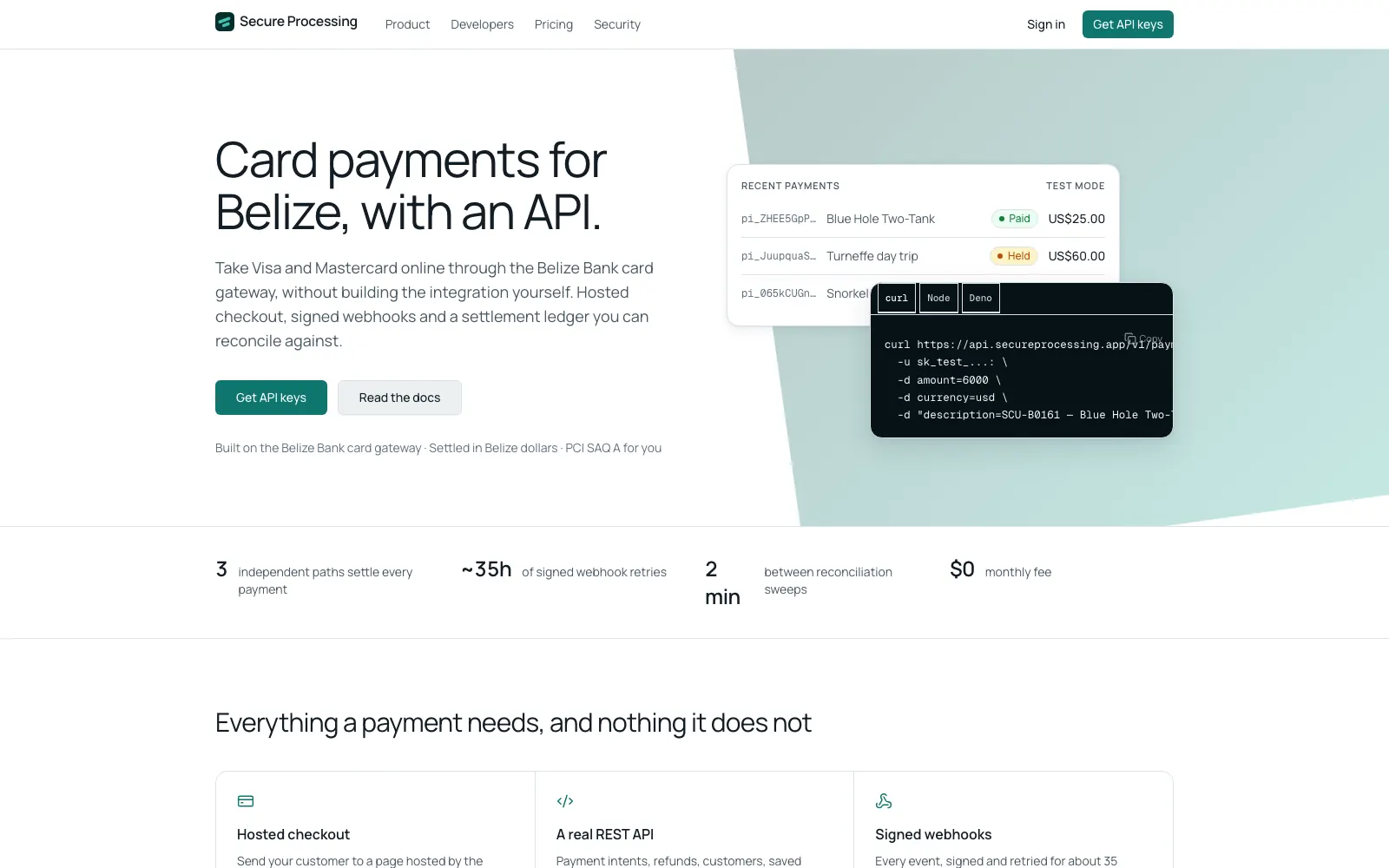
Seascape, our booking platform for dive and tour shops in Belize, takes card payments through a local Belizean bank, with deposits, pay-in-full and balance-due links. After building that connection for Seascape, we turned it into Secure Processing, a service for other Belize businesses that need to take cards online.
Secure Processing includes payment links, a ready-made checkout page, invoices customers pay online, refunds, card holds charged later, saved cards, fraud rules and a test mode, with a dashboard for balance, payouts and reports. It isn't open to businesses yet: it's built and in final testing with the bank ahead of launch, with Seascape as its first business.
Common questions
What is the cheapest way to accept online payments in Canada?
It depends on your volume and card mix. Flat-rate providers are simpler to predict; interchange-plus pricing is often cheaper as volume grows. Work out what each provider would have charged on last month's real sales before choosing.
Is Stripe or Square better for a small business in Canada?
Both have no monthly fee on standard pricing. Square's published online rate is 2.8% + 30¢ and Stripe's is 2.9% + CA$0.30 for domestic cards. Square is often chosen when in-person sales matter most; Stripe is often chosen for custom websites and software. Compare extra fees and payout timing too.
Does Moneris publish its online payment rates?
Yes. When we checked in October 2026, Moneris listed flat-rate pricing of 2.85% + $0.30 per credit card payment taken online or by phone, and $1.00 per online Interac debit payment. Its pricing page didn't state contract terms, so ask about them.
What's the difference between a payment gateway and a processor?
The gateway securely collects card details on your website or app. The processor moves the transaction between you, the card networks and the customer's bank. Many providers now bundle both, along with the merchant account that holds funds before payout.
Can customers pay with Interac online in Canada?
The original Interac Online service was wound down in 2024. Some providers accept Interac debit online in other ways, such as through Apple Pay or Google Pay, and Interac is introducing Interac Direct through its Konek platform.
Do I need to be PCI compliant if I use Stripe or Square?
Yes, every business that accepts cards has PCI responsibilities. Using the provider's hosted checkout or secure card fields keeps card data off your own systems, which keeps those responsibilities much smaller.
Sources
- Stripe: pricing in Canada (checked October 2026)
- Stripe: payouts documentation, first payout and Canada settlement timing (checked October 2026)
- Stripe: integration security guide
- Square Canada: processing fees (checked October 2026)
- Moneris: pricing (checked October 2026)
- Helcim: pricing (checked October 2026)
- PCI Security Standards Council: merchants
- Interac: accept online payments with Interac Direct
- Interac: business payment options
- The Police Credit Union: Interac Online decommissioning notice
Want help with this?
See our custom software services in Winnipeg.
More guides
- App vs Website for Small Business: What Do You Need? →
- How Much Does an App Cost in Canada? What Drives the Price →
- When to Replace Spreadsheets With Custom Software →
- Client Portal for Small Business: Do You Need One? →
- Website Cost in Winnipeg: What Changes the Price →
- Bilingual Website in Manitoba: Building an English/French Site →
- Website Not Generating Leads? A Guide for Manitoba Contractors →
- Manitoba Website Accessibility Requirements for Small Business →
- Funding a Website or Software in Manitoba: What's Open in 2026 →
- Booking Platform Commission vs Owning Your Booking System →
- Moving Off WordPress Without Losing Your Google Rankings →
- Shopify or a Custom Online Store? How to Choose →
- What a Small Business Booking System Needs →
- Google Business Profile Checklist for Winnipeg Businesses →