Bilingual Website in Manitoba: Building an English/French Site
By Jagassar ·
A bilingual website can open your business to French-speaking customers in Manitoba and across Canada. It also doubles the pages you have to write, check and keep up to date. This guide covers when French is worth it, what the rules actually say, and how to build an English/French site that stays in sync.
Do you need a French website?
Start with your customers, not the rules. Ask yourself:
- Do customers already call, email or walk in speaking French?
- Do you serve areas with French-speaking communities, such as St. Boniface or towns in the Red River valley?
- Do you sell to customers in Quebec or other parts of Canada?
- Do you bid on work for governments or public bodies that deliver services in French?
- Would a French site set you apart from competitors who only offer English?
If the answer to most of these is no, a well-built English site may be all you need for now. You can still plan for French later, so adding it doesn't mean rebuilding.
What the rules say for Manitoba businesses
This is general information, not legal advice. Check with a lawyer if your situation is unusual.
- Manitoba's French Language Services Policy applies to public bodies: government departments and their agencies, Crown corporations, certain utilities, and designated health and social services bodies. It doesn't list private businesses.
- The federal Use of French in Federally Regulated Private Businesses Act covers larger federally regulated businesses, such as banks, telecommunications companies and interprovincial transport, including in areas around Winnipeg. The Government of Canada says it is not yet in force, and that businesses under provincial jurisdiction are not subject to it.
- Quebec is different. Under its Charter of the French language, businesses that carry on business in Quebec must publish their commercial material in French, and consumers there have a right to a complete French version of a company's website. If you have operations in Quebec, check the Office québécois de la langue française's guidance.
In short, most private Manitoba businesses that only operate here aren't required to have a French website. It's a business decision. The exception to watch is contracts: if you deliver services on behalf of a public body, your contract may require French.
Separate pages or a language switcher?
There are two common ways a bilingual site gets built, and only one works well for search.
The better approach gives each language its own pages, with their own addresses. For example, /services for English and /fr/services for French. A language switcher in the header simply links from one version of a page to the matching version in the other language. Google recommends separate URLs for each language, rather than changing the language with cookies or browser settings.
The weaker approach keeps one address and swaps the text in place, often with a translation widget. Visitors can read it, but search engines usually only see one language. Google also warns against automatically sending people to a language based on their browser settings, because search engines may never find the other version.
A few details make the switcher easy to use:
- Put it in the same spot on every page, usually the top right.
- Label each language in its own language: "English" and "Français", not flags. Flags stand for countries, not languages.
- Send people to the same page in the other language, not back to the home page.
- Remember the choice, so the next page they open stays in their language.
Translation: people, machines, or both
Machine translation has improved a lot, and it's a useful first draft. It still makes mistakes with tone, industry terms and local usage. Canadian French also differs from the French used in France in vocabulary and some spelling, so a translation tool set to the wrong variety can sound off to local readers.
Google's spam policies list mass-produced pages made through automated transformations, including translating, as a form of abuse when the goal is to churn out low-value pages. A machine translation that a fluent person has reviewed and corrected is a different thing. It's useful content in another language.
A sensible approach for most small businesses:
- Use a professional translator or a fluent staff member for your most important pages: home, services, pricing and contact.
- Use machine translation as a starting draft for less important pages, then have a fluent person review it.
- Keep a short list of your own terms and how you translate them, so the same word is used every time.
- Translate the small things too: buttons, menus, error messages, image descriptions and page titles.
Keeping both languages in sync
The most common problem with bilingual sites isn't the launch. It's six months later, when the English page has a new price and the French page still shows the old one.
- Pick an editing system that links each English page to its French version, so you can see which pages need updating.
- Make updating both languages part of the job. A change isn't done until both versions are live.
- Only publish French for what you can keep current. A smaller French section that is correct beats a full copy that is out of date.
- Check both versions after each change, especially prices, hours, addresses and phone numbers.
SEO for two languages, and what hreflang does
Each language version should be able to rank on its own. That means each page has its own title, search description, headings and image descriptions in that language. Don't put English and French side by side on the same page. Google advises against it.
hreflang is a small piece of code that tells Google "this page and that page are the same content in different languages." It helps Google show French searchers the French page and English searchers the English one. Each page lists itself and every other version, using a short language code such as en or fr. The links must go both ways: if two pages don't point to each other, Google ignores the tags.
You can add hreflang in the page code, in your sitemap (the list of pages you give search engines), or in server headers. Google treats all three the same, so pick one. Google also suggests an x-default version for visitors whose language you don't offer, usually your English home page or a language choice page.
One thing hreflang doesn't do: it doesn't tell Google what language a page is in. Google works that out from the text itself. So a French page needs to actually be in French, including its title and headings.
If you have a Google Business Profile, keep your business details the same in both languages on the site, and make sure the pages you link from it load in the right language.
Editing both languages yourself
If you'll be making changes yourself, test the editing system before you commit to it. Ask to see:
- How you switch between the English and French version of a page while editing.
- Whether you can preview each language before publishing.
- What happens when you add a new page: does the French version get created too, or do you have to remember?
- Whether images, galleries and events can have different captions or descriptions in each language.
- Whether the editor offers a translation draft you can then correct.
Forms, bookings and emails in both languages
A French page that leads to an English-only form loses people at the worst moment. Check the whole path a customer takes:
- Form labels, help text and error messages in the visitor's language.
- Booking steps, dates and times in the right format for each language.
- Confirmation pages and confirmation emails sent in the language the customer used.
- Reminder emails, receipts and newsletters, with the customer's language saved so later messages match.
- A note in your inbox showing which language the customer used, so your reply matches.
If you can't answer in French yourself, say so politely on the French pages and tell people what to expect. That is better than surprising them later.
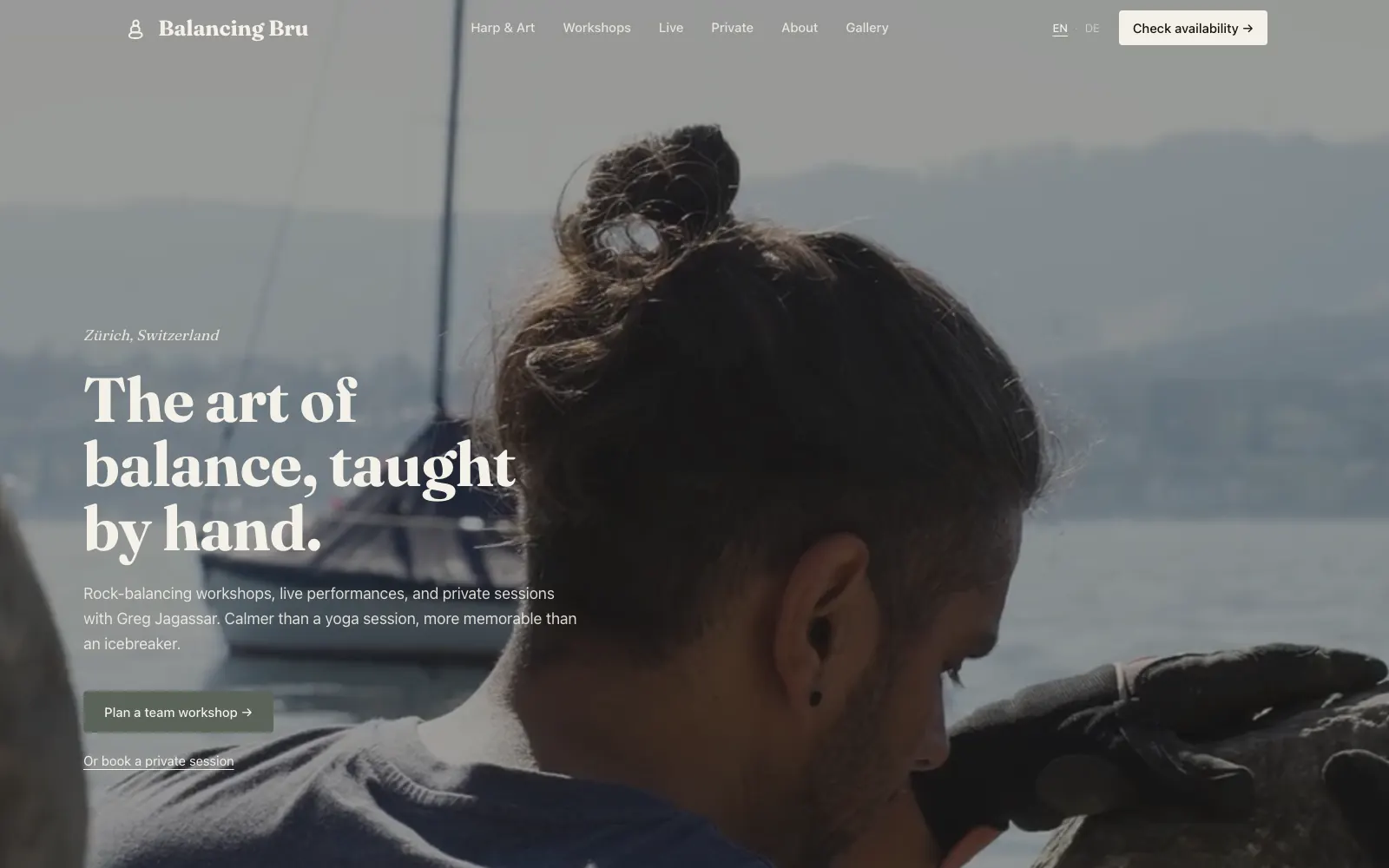
How we built a bilingual site for Balancing Bru
Balancing Bru is a rock-balancing artist in Zürich, so the languages there are English and German rather than French. The same principles apply. Workshops, live shows and private sessions can be booked through a step-by-step request in both languages, and the request lands in the artist's inbox.
The artist edits pages visually with a live preview and a media library, and can translate between English and German in one click from the editor. Every address from the old WordPress site was redirected to its new page, so existing Google rankings carried over.
Common questions
Do private businesses in Manitoba have to have a French website?
Generally no. Manitoba's French Language Services Policy covers public bodies such as government departments and Crown corporations, not private businesses. Rules can apply if you operate in Quebec, or if a contract with a public body requires French.
Is Google Translate good enough for a French version of my website?
It is a useful first draft, but it still gets tone, industry terms and Canadian French usage wrong. Have a fluent person review anything you publish, starting with your most important pages.
What is hreflang?
A small piece of code that tells Google which pages are the same content in different languages, so it can show each searcher the right version. Each page must list every version, including itself, and the links must go both ways.
Should my French pages use /fr/ in the address?
Giving each language its own address, such as /fr/ for French, is a simple and common approach. Google recommends separate URLs for each language rather than switching languages with cookies or browser settings.
Can I add French to my website later?
Yes, if the site is built with a second language in mind. Ask for language-ready page addresses, a switcher and an editor that supports translations from the start, even if you launch in English only.
Sources
- Government of Manitoba: The French Language Services Policy
- Government of Canada: An Act to Support the Use of French
- Office québécois de la langue française: Langue du commerce et des affaires
- Google Search Central: Tell Google about localized versions of your page
- Google Search Central: Managing multi-regional and multilingual sites
- Google Search Central: Spam policies for Google web search
Want help with this?
See our web design services in Winnipeg.
More guides
- App vs Website for Small Business: What Do You Need? →
- How Much Does an App Cost in Canada? What Drives the Price →
- When to Replace Spreadsheets With Custom Software →
- Client Portal for Small Business: Do You Need One? →
- Website Cost in Winnipeg: What Changes the Price →
- Website Not Generating Leads? A Guide for Manitoba Contractors →
- Manitoba Website Accessibility Requirements for Small Business →
- Funding a Website or Software in Manitoba: What's Open in 2026 →
- Booking Platform Commission vs Owning Your Booking System →
- Online Payments in Canada: Stripe vs Square vs Moneris vs Helcim →
- Moving Off WordPress Without Losing Your Google Rankings →
- Shopify or a Custom Online Store? How to Choose →
- What a Small Business Booking System Needs →
- Google Business Profile Checklist for Winnipeg Businesses →